Showing posts with label stuff i eat. Show all posts

Tuesday, November 12, 2013

Stuff I Eat: Yemas de Ávila


The lack of recent posts about my culinary adventures doesn't mean I haven't been trying anything and everything edible (and some things that would be, by most definitions, inedible). Quite the opposite, actually. I've been too busy eating to write about how much I've been eating.


Name: Yemas de Ávila (Yemas de Santa Teresa)

Translation: Avila egg cakes (Saint Teresa egg cakes)

So what is it exactly? It's a pastry typical of the province of Avila. It's egg yolks mixed with a syrup made of sugar, cinnamon, lemon and water. The result is a soft yellow confectionery that I can best describe as a mix between a pastry (because it's soft and sweet) and a candy (because it's small and totally unlike a traditional bread-based pastry).

Where I ate it: Avila, Spain. I popped into a traditional pastry shop (the city is loaded with them) and bought a box. They're gold in food form. I don't say that for their yellow color but rather because I paid 5 euros for a box of 12 tiny yemas.

Before trying it, I was thinking...: "These look like lemon drops, but the fact that 'yolk' is in their name is throwing me off."

Texture: Because I anticipated something resembling lemon drops, I wasn't expecting them to be soft. Needless to say, I was surprised (unpleasantly, at first) to find that yemas are indeed barely solid. The exterior is slightly crispy, but it dissolves on contact with your tongue and gives way to the treat's gloriously gooey innards.

Taste: Given the ingredients (read: lots of sugar), it's very sweet. It tastes like a soft ball of sugary goo with a touch of lemon, all of which is given consistency by the yolk. They're slightly reminiscent of a gum drop, but they're softer and just plain better. I thought I would be able to taste egg in the yemas, but much like the eggs used in any other pastry, the egg-like flavor is completely disguised in the pastry.

Verdict: Heavenly...and way too easy to eat way too many. They're tiny but incredibly sweet. I'm a serious addict to sweets, so I could easily down a few of these at a time. But if you're not a fan of sweets, these golden balls of saintly deliciousness aren't intended for you.

It'd be blasphemous for me not to like something named for Saint Teresa, given she's my patron saint and namesake...I'm not much for blasphemy.


Sunday, October 13, 2013

Nine things you thought wrong about Morocco

A Spanish friend and I took a week and traversed the gut of Morocco. Much like I described the derelict parts of Bulgaria, the desolate, dog-eared side of Morocco has its charm. The half-finished buildings and the missing windows and the trash-strewn fields and the "toilets" at roadside stops all contribute to the intrigue and offbeat beauty of Morocco, a country that doesn't try to hide itself behind blush and high heels. You can’t fully understand and experience a country in seven days, but we got a pretty extensive glimpse into Moroccan life on the road from Marrakech to Fez and back. It was us, our van, the Sahara Desert, the Atlas Mountains and hundreds of kilometers of open highway. And wow, was it incredible.

Tinghir, palm tree oasis in the Sahara

Atlas Mountains
I learned a lot in a short time on The Great Moroccan Road Trip. I realized that people know nothing about the country, that much of our “knowledge” of what Morocco is and isn’t comes from tall tales and TV shows. So, inspired by the bountiful tourist misconceptions, I’ve jotted down a list of things you thought wrong about the jewel of North Africa.

1. Police only want to rip off tourists.
This couldn't be further from the truth. I'd read horror stories of tourists being hassled for speeding and paying arbitrary fines on the spot. What if they took us for all we had? It's true the country is one giant speed trap. Police checkpoints are everywhere, and the speed limit signs are posted so close together it's impossible to obey them. But we passed through more than 15 stops, and every time, the officers saw we were tourists and let us on our way with a smile and a bit of elementary English or conversational Spanish.

2. The roads are awful.
Sure, they are not like U.S. highways, but anyone who expects them to be doesn't understand much about the world. Moroccan roads are narrow and generally lack asphalt shoulders, but they are in surprisingly good condition. The main and semi-main highways have gravel shoulders. We crossed the center of the country in a big van with no problem, and we didn’t use four-wheel drive. We navigated using street signs, a Michelin map and English/Spanish/broken French to ask for directions. We got lost a few times and cursed poor signage when we did. But guess what? We lived to tell the tale.


3. Going on a guided tour is the best way to see Morocco.
I don't doubt that the guided tours are great. But they aren't necessary. If you have someone who's comfortable handling tight curves on mountain roads and who's not intimidated by offensive and defensive driving, I'd recommend a road trip. The guided tours post their exact itineraries online. It's easy to find one you like and use it to plan your own adventure. Let it be known, however, that renting a car wasn't cheap (250 euros for four days, including extra insurance for peace of mind. I’ve read it’s cheaper if you rent from a local company.). Despite the expense, having a car was great for convenience and comfort. Do be advised, though, that passing through towns is like an obstacle course, but not a fun one. The only reward at the course's end is knowing you didn't crash into a donkey cart or run over a cloaked woman. The country is full of long-haul cabs that take tourists and locals to and fro, but they pack as many people as possible (plus one or two more) into those aging Mercedes. I imagine traveling in an overcrowded hotbox could make the red rocks of the Sahara look a little bit like the bowels of hell. 

Defensive driving at its finest.

Driving gave us the freedom to soak in views like this. 

4. Morocco is incredibly cheap.
This may have been true before the tourist boom, but Morocco is no off-the-map destination. It’s full of tourists, and the prices reflect that. You can find beds at well-reviewed youth hostels for about 9 euros a night per person (which is comparable to Budapest and Prague, for example), whereas nicer hotels are closer to 20 euros per person and up. It’s en vogue to renovate old homes and convert them into gorgeous hotels, and for how nice they are, they’re definitely cheaper than a similar lodging option in, say, Italy or Paris. But don’t think visiting Morocco with a clinking coin purse is sufficient. You’re going to spend a decent chunk of change if you want to see more than one city. You can find traditional food for around 3 euros a person, but if you’re more comfortable eating at tourist restaurants, expect to pay closer to 8 or 10 euros for a meal. As for souvenirs in the medinas, hard-line negotiation is a must. At most you should pay half the price vendors initially quote. 

The souks, Marrakech

5. Since it’s touristy, everyone speaks good English. 
Morocco is the first place I’ve visited where people were much more inclined to speak Spanish than English. Geographically, it makes sense, of course, given that it’s directly south of Spain. In Marrakech, the vendors spoke just about any language necessary to lure a customer in for a sale. But outside of Marrakech, I noticed English was much less common. When we camped in the Sahara, the workers all spoke great Spanish but limited English. Along our driving route, neither English nor Spanish worked well. Broken French was the best – and often only – way to communicate. This isn’t to say you can’t make it on English alone, of course, but it’s likely to be more difficult.

6. The Sahara Desert is made up of endless sand dunes.
You know that awesome footage you’ve seen on National Geographic of undulating mountains of powder-fine sand kissed by the desert sun? Most of the Moroccan Sahara is nothing like that. Much of it is rocky and dusty. Some is flat. Some is mountainous. The rest falls somewhere between the two extremes. There are two small parts, called the Erg Chebbi and Erg Chigaga, that are as orange and dune-y and spectacular as what Google boasts. But for reference, the Erg Chebbi is only 22 kilometers across at its widest. Think of that in terms of the expansiveness of the Sahara and you’ll realize it’s only a small blip on the map. 

This is the Sahara. 

So is this. 

And this. 

And this. 

And this, too. 

7. Moroccan men love to harass Western women.
Yes, some of them do offer camels in exchange for ladies, but the only time I heard such a proposal, it was a joke. Moroccans are sales people, and they’re tactical. If they see you looking at a map, they’ll offer to guide you to the location, hoping for a small service tip at the end. If you stop to look at their wares at a stand in the medina, they’ll often badger you to go inside to browse further and talk prices. The closer you get to the desert dunes, where tourism is the area’s lifeblood, the worse the hounding gets. Men will block the highway or flank your vehicle on their motorcycles to promote their sales pitch. But from what I saw, they did that to men and women alike. 

It didn't take much coercing to get me into the shops. 
8. Morocco is all desert. 
I'll let photos speak to the country's geographical diversity. 


9. The food and water will kill you. 
Oh, how we Westerners love to have our food packaged or pasteurized.  In Morocco, if you refuse to try any local fare, your overall experience will be as sterile as that pre-made supermarket sandwich you opted for at lunch. I found a dead, petrified bee in the taffy I bought from a street vendor, and I ate it anyway. I ate fresh salads, olives and fruit. I drank juice in the mornings and ordered traditional pastilla and cous cous at afternoon meals. At the Marrakech food market, I went as far as to eat the leftover eggplant off a stranger’s plate after she left (that was probably a bit too far, admittedly). In the end, my gut didn’t violently scold me, and as far as I know, my body hasn’t been ravaged by a tapeworm or pathogen. I never did drink the water, but I did brush my teeth with it. I wouldn't necessarily recommend my careless approach to eating whatever I saw, but a little culinary adventure is healthy. 

Delicious mixed salad

Pastilla, a traditional dish (often described as a "meat pie" of chicken) in a crepe-like crispy shell and topped with powdered sugar and cinnamon

Beautiful traditional sweets

Marrakech food market

So, with all that said, here’s to living and learning, to debunking myths and to spreading truth in a world of tales. 

Wednesday, June 26, 2013

Stuff I eat: Lengua con alcaparras (tongue with capers)

I've been globetrotting for a while and journeyed back to the homeland last week, so I've been missing in action around here. I'll try to catch up as best I can.

I didn't intend for every food I featured on here to be gross, bizarre, better-in-the-garbage-than-on-your-plate type stuff. But it's managed to work out that way so far, and today's entry is no exception.


Source

Name: Llengua amb taperes

Translation: The name above is in Mallorquin, the local language of Majorca. It'd be "lengua con alcaparras" in Spanish and in English "tongue with capers," which are the unripened buds of a plant found in the Mediterranean.

So what is it exactly? It's veal tongue - boiled, peeled and cooked with onions, capers and tomatoes.

Where I ate it: Cura, Majorca, Spain (a small town in Majorca, one of the Balearic Islands)

Before trying it, I was thinking...: "It's amazing how many times I find myself in a situation where I'm eating oft-discarded animal parts. And if my dad were here he'd tell me I'd never eat this if he put it on my plate back home."

Texture: As tender as it gets. Knife not needed. You don't even need teeth, really. You could gum the stuff and enjoy it just the same. Now, in my last post about oxtail, I also talked about incredible tenderness but in a negative way. I said oxtail was so tender that it lacked substance. The good news is that veal tongue didn't dissolve in the same way oxtail did. You don't have to chew the tongue, but it doesn't immediately disintegrate either. It was a slow melt-in-the-mouth, one you could appreciate and enjoy. Luckily, the meat (which is really mostly muscle and fat) didn't linger long enough for me to really think about the fact that the stuff falling apart on my tongue was, well, tongue.

Taste: This may or may not be surprising, but the tongue tastes like...beef! Even better than that ambiguously generic "beef" description: It actually tasted like roast. Yes, roast. OK, wipe that disgusted look off your face and think about this: As this guy explains it, round steak, for example, is none more glamorous than butt. If you can eat butt, you can eat tongue.

As for the capers, although familiar to people raised in the Mediterranean (or in Mediterranean-like climates), they're nothing like anything this Midwesterner had tasted before. They're tiny but packed with flavor. They've got a tart, slightly bitter punch. They don't taste like Greek olives but have a similar sort of mild kick. Just try them.

Verdict: Absolutely delicious. I owe my Mallorquin friends big time for exposing me to two gross-but-actually-not-gross dishes: tongue and frito mallorquin, which is liver and blood. I enjoyed the tongue so much that I'm dying to try a tongue taco at a traditional Mexican taqueria.

I think there's one saying that's perfect here: One man's trash is another man's treasure. So here's to eating trash - and liking it.

Un saludo,
Teresa

Tuesday, May 28, 2013

Stuff I eat: Rabo de toro

I'm going to keep citing Anthony Bourdain until I run out of references. His quotes are like strings of sometimes-vulgar-but-always-poignant poetry: “That without experimentation, a willingness to ask questions and try new things, we shall surely become static, repetitive, moribund.” It's with that Bourdain-inspired mindset that I've tried blood sausage, pig ears, liver and...

Source
Name: Rabo de toro

Translation: Oxtail (the name used to refer to the tail of an actual ox, but it seems to have stuck even though what is served presently is the tail of cows and steers.)

So what is it exactly? Just what it sounds like. It's a traditional dish in Cordoba, served with the meat on the tail bone and bits of solidified fat. From what I'm told, it's traditionally seasoned with garlic, onion and vegetables to form a sort of stew. I tried it (for the second time) at a traditional Cordobese restaurant, assuming that if it was going to be life-alteringly delicious anywhere in Spain, it'd be there.

Where I ate it: Cordoba, Spain

Before trying it, I was thinking...: "I'm all for parts conservation and getting the most out of a slaughtered animal, but this really doesn't look good."

Texture: The meat is extremely tender and moist, and that's typically one of the dish's most lauded qualities. No chewing is required. Normally tenderness is the mark of a good cut, but I found oxtail to be so tender that it lost substance and so moist it bordered on slimy. (Keep in mind this is based entirely on my unenlightened culinary opinion. Many people love this dish.)

Taste: From what I could taste of the meager amount of meat on the bones, the meat was similar in taste to ribs (again, I warn you of my untrained palate). You're thinking, "Teresa, ribs are delicious." You're right, but the potential deliciousness of oxtail, which I think of as rump roast's ugly cousin, was drowned out by off-putting texture and yellow gelatinous fat.

Verdict: I wouldn't order oxtail in a restaurant because it'd cost me an hour's worth of private English lessons, and I'd rather spend that 10 to 15 euros on blood sausage or squid in ink than on oxtail. However, if someone else was paying, or if I was a guest in someone's home, I'd eat it again without quarrel.

Wednesday, April 17, 2013

"Stuff I Eat" - Spanish morcilla

I don't intend to reference Anthony Bourdain -- the "celebrity chef/world traveler/pithy quote machine/professional wise ass," as I described him last time -- in every food post, but it's just inevitable in this one. The dude loves "black pudding" for reasons I never quite understood. Coagulated blood and lard stuffed into intestinal casings just didn't pique my appetite. Any food for which you can say "the fresher the blood, the better" scares me a bit.

Even so, for a long time, I was admittedly intrigued by Bourdain's affinity for a food that looks like a bloody stool. When in Spain, do as the Spaniards do. That's my motto, and I'm sticking to it. In my inaugural issue of "Stuff I Eat," I mentioned that I'd be willing to eat a "bulging, deep-red intestine casing stuffed with throwaway mammal parts" if the opportunity presented itself. I meant it as much as a figure of speech as a legitimate vow, but I soon found a bulging intestine on my plate.  


Name: Morcilla de Guadalupe

Translation: Blood sausage, or "black pudding," from Guadalupe, Extremadura

So what is it exactly? Ingredients vary by country and region. As is obvious, blood is the star ingredient that gives the dish its off-putting name. Fillers can include barley, pork, beef, rice, onions, fat, cornmeal, chestnuts, potatoes, oatmeal or whatever else tickles the preparer's fancy, I suppose. I tried various kinds in Guadalupe, a small Extremaduran town that's famous for its blood sausage. One type had potatoes, I remember. But the one I'm featuring here is the most traditional; it had pig lard, cayenne pepper (or something of the sort to give it kick) and pig blood for sure. There may have been onions, garlic and cabbage, which are all typical ingredients, but I can't confirm that.

Where I ate it: At a small cafe near the monastery in Guadalupe, Extremadura

Before trying it, I was thinking...: "I've already eaten way too many typical-of-the-area sweets today, so if I'm going to pack my belly even more, this stuff better be dang good."

Texture: Very soft, even crumbly. Some people say "pudding-like," hence the name "black pudding," but from what I experienced, that's a misnomer. It's not creamy in the way I imagine pudding, but to each his own. Neither is it like the inside of a hotdog or typical sausage, which are more solid, less moist, and they don't fall apart in a dissolve-in-your-mouth kind of way, like morcilla does.

Taste: I'm not a food writer. I have no idea how to describe tastes and textures and presentation in an eloquent way that really conveys my experience. I can tell you what morcilla didn't taste like, though. It didn't taste like ground beef or pork; it didn't taste like sausage; it didn't taste like lard. It did have a strong flavor of cayenne pepper or whatever the spicy bit was. And given that there's blood in the sausage, it did have a hint of metallic-ness.

Verdict: Delicious and filling. It's not something that I could eat a lot of because it's got a unique flavor that could quickly become too much of a good thing. But given the chance to try it again, I wouldn't hesitate.

Other types of morcilla de Guadalupe that I tried. I don't remember what the darker one was, but the orange one was blood, mashed potatoes and something spicy.

Friday, March 22, 2013

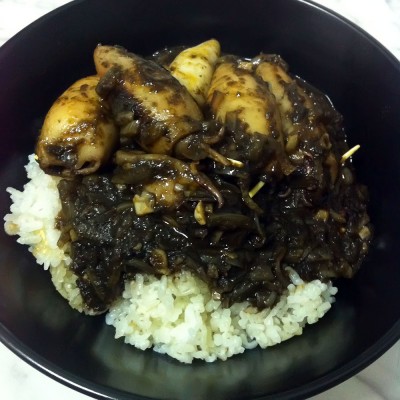
"Stuff I Eat," the inaugural issue - Chipirones en su tinta con arroz

“Do we really want to travel in hermetically sealed popemobiles through the rural provinces of France, Mexico and the Far East, eating only in Hard Rock Cafes and McDonalds? Or do we want to eat without fear, tearing into the local stew, the humble taqueria's mystery meat, the sincerely offered gift of a lightly grilled fish head? I know what I want. I want it all. I want to try everything once.”

There's no one wiser than celebrity chef/world traveler/pithy quote machine/professional wise ass Anthony Bourdain, at least when it comes to the profundity of food and travel. He'll go anywhere and eat anything, no matter how shady the establishment, how raw the meat, how undead the fare.

I'm no foodie, but a girl's gotta eat. So I'm embarking on a a food adventure of my own. It's a challenge that really isn't a challenge at all: to try something new every week and write about it.

That pathogen-laden bottom feeder? Give me a hearty sidedish and a nearby bathroom and I'll try it. That foul cheese whose mold is spawning grandchildren mold of its own? I'll try it. That bulging, deep-red intestine casing stuffed with throwaway mammal parts? I'll try it.

Hungry yet?

But seriously, considering I have no idea what half of the food is on any given menu regardless of where I travel, it shouldn't be too hard to dominate this challenge. Food and culture are intricately linked, especially in Spain, so I figure it's wise to flavor my experience a bit.

So here goes nothing: "Stuff I Eat," the inaugural issue. 

 Source

Name: Chipirones en su tinta con arroz

Translation: European squid in ink with rice

So what is it exactly? It's squid - full-bodied or sliced into rings - served with rice in an ink sauce flavored with garlic, onion, peppers, tomatoes, fish/chicken stock, etc. The fixings vary by the preparer, of course.

Where I ate it: In Don Benito, Spain, at a restaurant called "Cerveceria Gambrinus."

Before trying it, I was thinking...: "It kind of looks like the squid pooped on my rice." Then I wondered, "Do squid poop?"

Texture: Rubbery, gummy, as you might imagine. But it's not like I had to chomp mightily to get it down. I've eaten seafood in the past that pretty much exhausted my jaw. Fortunately, this wasn't like that. As for the ink sauce, it had the consistency of regular gravy.

Taste: Not a lot of it. It was supposed to be rich in garlic and onion, but it lacked a kick. The squid bodies themselves, which inside contained their tentacles, didn't have any notable flavor, either. It was a bit lifeless...pun intended?

Verdict: This dish has potential, and I would try it again without hesitation somewhere along the coast, where the squid is fresh and the preparation is a bit more inspired. 

Source

Until next time...
Un saludo,
Teresa
Related Posts Plugin for WordPress, Blogger...