Showing posts with label eat. Show all posts

Tuesday, November 12, 2013

Stuff I Eat: Yemas de Ávila


The lack of recent posts about my culinary adventures doesn't mean I haven't been trying anything and everything edible (and some things that would be, by most definitions, inedible). Quite the opposite, actually. I've been too busy eating to write about how much I've been eating.


Name: Yemas de Ávila (Yemas de Santa Teresa)

Translation: Avila egg cakes (Saint Teresa egg cakes)

So what is it exactly? It's a pastry typical of the province of Avila. It's egg yolks mixed with a syrup made of sugar, cinnamon, lemon and water. The result is a soft yellow confectionery that I can best describe as a mix between a pastry (because it's soft and sweet) and a candy (because it's small and totally unlike a traditional bread-based pastry).

Where I ate it: Avila, Spain. I popped into a traditional pastry shop (the city is loaded with them) and bought a box. They're gold in food form. I don't say that for their yellow color but rather because I paid 5 euros for a box of 12 tiny yemas.

Before trying it, I was thinking...: "These look like lemon drops, but the fact that 'yolk' is in their name is throwing me off."

Texture: Because I anticipated something resembling lemon drops, I wasn't expecting them to be soft. Needless to say, I was surprised (unpleasantly, at first) to find that yemas are indeed barely solid. The exterior is slightly crispy, but it dissolves on contact with your tongue and gives way to the treat's gloriously gooey innards.

Taste: Given the ingredients (read: lots of sugar), it's very sweet. It tastes like a soft ball of sugary goo with a touch of lemon, all of which is given consistency by the yolk. They're slightly reminiscent of a gum drop, but they're softer and just plain better. I thought I would be able to taste egg in the yemas, but much like the eggs used in any other pastry, the egg-like flavor is completely disguised in the pastry.

Verdict: Heavenly...and way too easy to eat way too many. They're tiny but incredibly sweet. I'm a serious addict to sweets, so I could easily down a few of these at a time. But if you're not a fan of sweets, these golden balls of saintly deliciousness aren't intended for you.

It'd be blasphemous for me not to like something named for Saint Teresa, given she's my patron saint and namesake...I'm not much for blasphemy.


Wednesday, June 26, 2013

Stuff I eat: Lengua con alcaparras (tongue with capers)

I've been globetrotting for a while and journeyed back to the homeland last week, so I've been missing in action around here. I'll try to catch up as best I can.

I didn't intend for every food I featured on here to be gross, bizarre, better-in-the-garbage-than-on-your-plate type stuff. But it's managed to work out that way so far, and today's entry is no exception.


Source

Name: Llengua amb taperes

Translation: The name above is in Mallorquin, the local language of Majorca. It'd be "lengua con alcaparras" in Spanish and in English "tongue with capers," which are the unripened buds of a plant found in the Mediterranean.

So what is it exactly? It's veal tongue - boiled, peeled and cooked with onions, capers and tomatoes.

Where I ate it: Cura, Majorca, Spain (a small town in Majorca, one of the Balearic Islands)

Before trying it, I was thinking...: "It's amazing how many times I find myself in a situation where I'm eating oft-discarded animal parts. And if my dad were here he'd tell me I'd never eat this if he put it on my plate back home."

Texture: As tender as it gets. Knife not needed. You don't even need teeth, really. You could gum the stuff and enjoy it just the same. Now, in my last post about oxtail, I also talked about incredible tenderness but in a negative way. I said oxtail was so tender that it lacked substance. The good news is that veal tongue didn't dissolve in the same way oxtail did. You don't have to chew the tongue, but it doesn't immediately disintegrate either. It was a slow melt-in-the-mouth, one you could appreciate and enjoy. Luckily, the meat (which is really mostly muscle and fat) didn't linger long enough for me to really think about the fact that the stuff falling apart on my tongue was, well, tongue.

Taste: This may or may not be surprising, but the tongue tastes like...beef! Even better than that ambiguously generic "beef" description: It actually tasted like roast. Yes, roast. OK, wipe that disgusted look off your face and think about this: As this guy explains it, round steak, for example, is none more glamorous than butt. If you can eat butt, you can eat tongue.

As for the capers, although familiar to people raised in the Mediterranean (or in Mediterranean-like climates), they're nothing like anything this Midwesterner had tasted before. They're tiny but packed with flavor. They've got a tart, slightly bitter punch. They don't taste like Greek olives but have a similar sort of mild kick. Just try them.

Verdict: Absolutely delicious. I owe my Mallorquin friends big time for exposing me to two gross-but-actually-not-gross dishes: tongue and frito mallorquin, which is liver and blood. I enjoyed the tongue so much that I'm dying to try a tongue taco at a traditional Mexican taqueria.

I think there's one saying that's perfect here: One man's trash is another man's treasure. So here's to eating trash - and liking it.

Un saludo,
Teresa

Wednesday, April 17, 2013

"Stuff I Eat" - Spanish morcilla

I don't intend to reference Anthony Bourdain -- the "celebrity chef/world traveler/pithy quote machine/professional wise ass," as I described him last time -- in every food post, but it's just inevitable in this one. The dude loves "black pudding" for reasons I never quite understood. Coagulated blood and lard stuffed into intestinal casings just didn't pique my appetite. Any food for which you can say "the fresher the blood, the better" scares me a bit.

Even so, for a long time, I was admittedly intrigued by Bourdain's affinity for a food that looks like a bloody stool. When in Spain, do as the Spaniards do. That's my motto, and I'm sticking to it. In my inaugural issue of "Stuff I Eat," I mentioned that I'd be willing to eat a "bulging, deep-red intestine casing stuffed with throwaway mammal parts" if the opportunity presented itself. I meant it as much as a figure of speech as a legitimate vow, but I soon found a bulging intestine on my plate.  


Name: Morcilla de Guadalupe

Translation: Blood sausage, or "black pudding," from Guadalupe, Extremadura

So what is it exactly? Ingredients vary by country and region. As is obvious, blood is the star ingredient that gives the dish its off-putting name. Fillers can include barley, pork, beef, rice, onions, fat, cornmeal, chestnuts, potatoes, oatmeal or whatever else tickles the preparer's fancy, I suppose. I tried various kinds in Guadalupe, a small Extremaduran town that's famous for its blood sausage. One type had potatoes, I remember. But the one I'm featuring here is the most traditional; it had pig lard, cayenne pepper (or something of the sort to give it kick) and pig blood for sure. There may have been onions, garlic and cabbage, which are all typical ingredients, but I can't confirm that.

Where I ate it: At a small cafe near the monastery in Guadalupe, Extremadura

Before trying it, I was thinking...: "I've already eaten way too many typical-of-the-area sweets today, so if I'm going to pack my belly even more, this stuff better be dang good."

Texture: Very soft, even crumbly. Some people say "pudding-like," hence the name "black pudding," but from what I experienced, that's a misnomer. It's not creamy in the way I imagine pudding, but to each his own. Neither is it like the inside of a hotdog or typical sausage, which are more solid, less moist, and they don't fall apart in a dissolve-in-your-mouth kind of way, like morcilla does.

Taste: I'm not a food writer. I have no idea how to describe tastes and textures and presentation in an eloquent way that really conveys my experience. I can tell you what morcilla didn't taste like, though. It didn't taste like ground beef or pork; it didn't taste like sausage; it didn't taste like lard. It did have a strong flavor of cayenne pepper or whatever the spicy bit was. And given that there's blood in the sausage, it did have a hint of metallic-ness.

Verdict: Delicious and filling. It's not something that I could eat a lot of because it's got a unique flavor that could quickly become too much of a good thing. But given the chance to try it again, I wouldn't hesitate.

Other types of morcilla de Guadalupe that I tried. I don't remember what the darker one was, but the orange one was blood, mashed potatoes and something spicy.

Friday, March 22, 2013

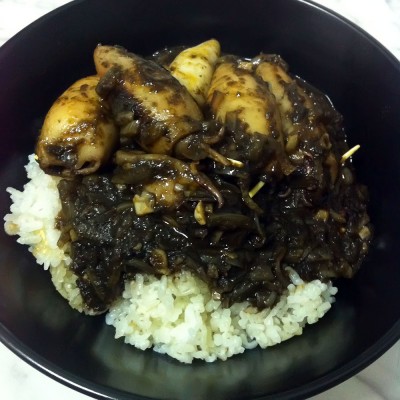
"Stuff I Eat," the inaugural issue - Chipirones en su tinta con arroz

“Do we really want to travel in hermetically sealed popemobiles through the rural provinces of France, Mexico and the Far East, eating only in Hard Rock Cafes and McDonalds? Or do we want to eat without fear, tearing into the local stew, the humble taqueria's mystery meat, the sincerely offered gift of a lightly grilled fish head? I know what I want. I want it all. I want to try everything once.”

There's no one wiser than celebrity chef/world traveler/pithy quote machine/professional wise ass Anthony Bourdain, at least when it comes to the profundity of food and travel. He'll go anywhere and eat anything, no matter how shady the establishment, how raw the meat, how undead the fare.

I'm no foodie, but a girl's gotta eat. So I'm embarking on a a food adventure of my own. It's a challenge that really isn't a challenge at all: to try something new every week and write about it.

That pathogen-laden bottom feeder? Give me a hearty sidedish and a nearby bathroom and I'll try it. That foul cheese whose mold is spawning grandchildren mold of its own? I'll try it. That bulging, deep-red intestine casing stuffed with throwaway mammal parts? I'll try it.

Hungry yet?

But seriously, considering I have no idea what half of the food is on any given menu regardless of where I travel, it shouldn't be too hard to dominate this challenge. Food and culture are intricately linked, especially in Spain, so I figure it's wise to flavor my experience a bit.

So here goes nothing: "Stuff I Eat," the inaugural issue. 

 Source

Name: Chipirones en su tinta con arroz

Translation: European squid in ink with rice

So what is it exactly? It's squid - full-bodied or sliced into rings - served with rice in an ink sauce flavored with garlic, onion, peppers, tomatoes, fish/chicken stock, etc. The fixings vary by the preparer, of course.

Where I ate it: In Don Benito, Spain, at a restaurant called "Cerveceria Gambrinus."

Before trying it, I was thinking...: "It kind of looks like the squid pooped on my rice." Then I wondered, "Do squid poop?"

Texture: Rubbery, gummy, as you might imagine. But it's not like I had to chomp mightily to get it down. I've eaten seafood in the past that pretty much exhausted my jaw. Fortunately, this wasn't like that. As for the ink sauce, it had the consistency of regular gravy.

Taste: Not a lot of it. It was supposed to be rich in garlic and onion, but it lacked a kick. The squid bodies themselves, which inside contained their tentacles, didn't have any notable flavor, either. It was a bit lifeless...pun intended?

Verdict: This dish has potential, and I would try it again without hesitation somewhere along the coast, where the squid is fresh and the preparation is a bit more inspired. 

Source

Until next time...
Un saludo,
Teresa
Related Posts Plugin for WordPress, Blogger...