Showing posts with label southern spain. Show all posts

Tuesday, November 19, 2013

On being an American introvert in Spain

After a weekend in a mountain house with 12 Spaniards, this post seems timely...

Spanish is a social culture, which makes it an anomaly of sorts when compared to individual-based America. Spain is all about evening walks on the crowded city-center sidewalks, where old men are dapper in cardigans, slacks and leather shoes. Here, friends go to each other's homes for mid-afternoon coffee and company. Spaniards meet on weekend afternoons to tapear, in which they sip beers and order dishes to be picked over by the group. They talk, they laugh, they kiss hello and sometimes goodbye, too. They thrive on the communal experience, on shared moments together and conversation over long lunches and drink dates. To not be social is to not be Spanish.

I love this picture I took in Avila because it sums up Spanish culture so perfectly. 

Which puts me, an introvert and an American to boot, in a tough spot sometimes. Let me begin this spiel by noting that being introverted and being anti-social are not the same. The latter is a personality disorder, actually. Introverts don't hate people or parties or talking or groups of three or four or five. Like most humans, we enjoy revelry, banter, fun and togetherness, but we reach a point in which we are simply drained by the beauty of it all. We replenish our energy in the most glorious way possible, I think: by being alone. I love the silence and the tranquility of being solo, and quite frankly, I need it.

My need to be alone doesn't necessarily defy American cultural norms. Sure, some of my friends think I'm a weirdo when I am noticeably delighted to be holed up solo, but it's not widely frowned upon. Here in Spain, from what I've gathered, at least, being alone or doing things alone isn't quite as acceptable. There are times I want to eat alone. There are times when I'd rather not have coffee at her house or my house. Because as a teacher, I'm surrounded by people and energy and commotion and chatter and screaming every day. So after work, sometimes I just want to go to my room and let my thoughts fight each other for my attention. There is no better noise to me than deafening silence.

Even so, I try to accept any invitation offered to me as a way to embrace Spanish culture and experience everything I can during my short time here. But you can't fight nature. Sometimes I feel like a gorilla in captivity because like him, I've grown comfortable in an environment that's entirely unnatural for me. But there are times when I bang my head against the glass or mindlessly spin in circles, thus showing there's a part of me that still knows I'm going against the grain here.

The emphasis on relationships and community and living life with people instead of just around them is something I admire about Spanish culture. And I envy the people who can embrace that each and every day. For me, it's a challenge, but I'm making the effort and making friends. So here's to different cultures challenging us, teaching us and changing us.

Saturday, April 27, 2013

Feria de abril

I imagine Sevilla's "Feria de abril" might be like the Texas State Fair or any traditional event celebrating the southern U.S. If you're from there, such festivities are cultural gems. If you're not, they're an excuse for southern pride to puke all over the place. The southern U.S. and southern Spain are alike in that they have subcultures that are very much alive, deeply ingrained and wildly celebrated. Both "souths" have customs that are exclusive, esoteric and shall we say slightly obnoxious?

You could say Sevilla's April fair is obnoxious, exclusive and esoteric, but in the most awesome way possible. There are lots of fancy, expensive flamenco dresses, overdone makeup, guys getting drunk on horseback, fried food and booze. Lots of booze -- including the traditional drink, rebujito, made of white wine and Sprite. A network of more than 1,000 casetas, which are individual bar/reception areas set up exclusively for the event, fill the fairgrounds. To get into all but the handful of public ones, you have to know someone inside. The fair is loud and hot and a bit circus-like. The bathrooms are as close as it gets to urge-reversing, and you have to weave through piles of horse poop in the streets.

On the other hand, it's alive, vibrant, merry and good ol' fun. Relatively cheap drinks, colorful characters and ridiculously beautiful people abound (the beautiful people part was kind of sickening, actually.) The dance floors are full of immaculate women twirling and stomping the Sevillana, the region's typical folk dance.

I'd love to go back next year. I had a blast (and I love Sevilla anyway). But next time I'm going to dress as a Sevillana, and I'll come equipped with a dance move or two.

Un saludo,
Teresa

Entrance to the fair

General debauchery


Entrance to one of the casetas


One of the casetas

Way too adorable

Caseta

Just the police taking pictures of each other

My roommate and I with one of the horsemen

Some Sevillanos took us for a ride through the fair (and then the police told them to drop us off because guiris who aren't dressed in typical attire aren't allowed on horseback).


Wednesday, April 17, 2013

"Stuff I Eat" - Spanish morcilla

I don't intend to reference Anthony Bourdain -- the "celebrity chef/world traveler/pithy quote machine/professional wise ass," as I described him last time -- in every food post, but it's just inevitable in this one. The dude loves "black pudding" for reasons I never quite understood. Coagulated blood and lard stuffed into intestinal casings just didn't pique my appetite. Any food for which you can say "the fresher the blood, the better" scares me a bit.

Even so, for a long time, I was admittedly intrigued by Bourdain's affinity for a food that looks like a bloody stool. When in Spain, do as the Spaniards do. That's my motto, and I'm sticking to it. In my inaugural issue of "Stuff I Eat," I mentioned that I'd be willing to eat a "bulging, deep-red intestine casing stuffed with throwaway mammal parts" if the opportunity presented itself. I meant it as much as a figure of speech as a legitimate vow, but I soon found a bulging intestine on my plate.  


Name: Morcilla de Guadalupe

Translation: Blood sausage, or "black pudding," from Guadalupe, Extremadura

So what is it exactly? Ingredients vary by country and region. As is obvious, blood is the star ingredient that gives the dish its off-putting name. Fillers can include barley, pork, beef, rice, onions, fat, cornmeal, chestnuts, potatoes, oatmeal or whatever else tickles the preparer's fancy, I suppose. I tried various kinds in Guadalupe, a small Extremaduran town that's famous for its blood sausage. One type had potatoes, I remember. But the one I'm featuring here is the most traditional; it had pig lard, cayenne pepper (or something of the sort to give it kick) and pig blood for sure. There may have been onions, garlic and cabbage, which are all typical ingredients, but I can't confirm that.

Where I ate it: At a small cafe near the monastery in Guadalupe, Extremadura

Before trying it, I was thinking...: "I've already eaten way too many typical-of-the-area sweets today, so if I'm going to pack my belly even more, this stuff better be dang good."

Texture: Very soft, even crumbly. Some people say "pudding-like," hence the name "black pudding," but from what I experienced, that's a misnomer. It's not creamy in the way I imagine pudding, but to each his own. Neither is it like the inside of a hotdog or typical sausage, which are more solid, less moist, and they don't fall apart in a dissolve-in-your-mouth kind of way, like morcilla does.

Taste: I'm not a food writer. I have no idea how to describe tastes and textures and presentation in an eloquent way that really conveys my experience. I can tell you what morcilla didn't taste like, though. It didn't taste like ground beef or pork; it didn't taste like sausage; it didn't taste like lard. It did have a strong flavor of cayenne pepper or whatever the spicy bit was. And given that there's blood in the sausage, it did have a hint of metallic-ness.

Verdict: Delicious and filling. It's not something that I could eat a lot of because it's got a unique flavor that could quickly become too much of a good thing. But given the chance to try it again, I wouldn't hesitate.

Other types of morcilla de Guadalupe that I tried. I don't remember what the darker one was, but the orange one was blood, mashed potatoes and something spicy.

Tuesday, April 2, 2013

Where in the world was Teresa Lostroh?

It's been a while since I've penned a travel dispatch. I'm trying to move away from the whole chronological "this is where I went, this is what I did" formula, but in case you're asking, "Where in the world was Teresa Lostroh?"....Stick with me. I promise there's an entertaining line or two.

1.) Tenerife, Canary Islands, Spain.
Went there for Los Carnavales, a Mardi Gras-esque liquor-fueled free-for-all. Was a tourist by day and a martian/some sort of Asian by night (we dressed up for Carnaval, in accordance with the custom). Felt like I landed on the moon when I visited the Teide Volcano, the world's third largest. Declared my panoramic shot of Los Gigantes (massive rock formations) the most epic ever. Ate three times my stomach's capacity at a typical Canarian eatery - and enjoyed every second of it. Got two Spanish friends to ask for a take-home food box for the first time in their lives. Broke my camera during an ill-advised self-timer attempt, therefore losing my beloved "vivid" setting forever.

Lunar landing?


The "Los Gigantes" panoramic


2). Mallorca (Majorca), Balearic Islands, Spain.
Was hoping for a glorious, snafu-less return trip to my favorite place on Earth. Went to the Cap de Fomentor peninsula on the island's northeastern tip, where I captured more epic panoramics and several Awkward Family Photo shots with my roommate. Also went to Sa Calobra, a remote cove reached by a mess of winding mountain roads. Went out, got my iPhone 4S and wallet stolen, effectively losing all photo evidence of the trip. So much for snafu-less. Thank goodness for memories. Ate fresh oranges from my friend's orange tree. I think the saying goes something like, "Once you go fresh oranges, you never go back." Let Mallorquin food win my heart even more (snails, bread, squid, vegetables, frito mallorquin, etc.) Spent Sunday in the obnoxiously Anglo neighborhood of Magaluf, where Spanish is a foreign language, Brits run amok shirtless and sunburned and Happy Hour starts at sunrise. Dipped into a bar at 7 p.m. that was packed with hammered middle-aged Brits reliving Spring Break. Jammed to lots of oldies and continued jamming even after the Brits' bedtime struck at 9:30.

Cap de Fomentor, Source

Magaluf, Source

3). Cordoba, Spain.
Split my heart in sixteenths as I fell in love with yet another colorful Spanish town. Got my mind blown by the Mezquita's wondrous mix of Christian and Muslim architecture. The place is huge. Went to a flamenco show in a nondescript basement on some Cordobese side street. Ate oxtail and flamenquin, a traditional dish of pork loin wrapped in ham, breaded and fried. Both dishes filled my belly but didn't change my life. Decided I must return when the city's ubiquitous residential courtyards are flush with May flowers.


Mezquita

Mezquita


4). Sevilla, Ronda, Trujillo, Granada, Malaga, and Nerja, Spain
Parents came to get a taste of la vida espanola. Cried when I met them at the train station in Sevilla (hey, it'd been five months). Launched a 10-day tourist blitz on this fine country. Did a generally terrible job of sharing with them the delights of Spanish cuisine (the best meal they had was at the hotel restaurant, without me). Made the mistake of ordering a fried seafood platter at a restaurant in the interior of the country. Acted as translator at a Case International implement dealer in Don Benito for my dad, who has an insatiable curiosity about agriculture no matter where he is. Took parents to Sevilla and Ronda, two places I'd already been. Forced my parents to be in more pictures together than they've been in over the past 35 years combined. That's not hyperbole. I'm serious. Went to a flamenco show in a kitschy tourist haunt in Sevilla. Enjoyed it despite its kitschy-ness. Fell in love with yet another pair of Spanish coastal towns, Malaga and Nerja. Pretty sure my parents are still talking about Malaga's marble sidewalks. Despite my love for Malaga and Nerja, thought both towns would be infinitely better if we could expel at least 70 percent of the northern Europeans and make the towns more authentically Spanish. Dad drove through snow - in southern Spain, of all places - to get to Granada, where that damned white powder covered the city for the first time in 25 years. Mom about lost her feet to frostbite while we tried (kind of in vain) to enjoy the Alhambra in the cold. Most importantly, was reminded of how awesomely loving, generous, fun and supportive my family is.

Plaza de Espana, Sevilla

Snowy Granada

Alhambra in Granada

Malaga from the fortress

5.) Toledo and Guadalupe, Spain
Have to wonder if my superlatives lose their weight when I overuse them: favorite, prettiest, most Spanish. But each trip manages to equal or top the previous. Loved Toledo's sublimely medieval core, which is on a hill reached by arched stone bridges. Toledo doesn't have the bright-colored buildings (much of the city is sandy stone) or the it-feels-like-this-entire-city-is-smiling vibe of Cordoba, but it's as genuinely Spanish. Guadalupe is what every small town should be: quaint, walkable, endearing, enchanting. It's all of those things despite the omnipresent tourist shops and carbon-copy signs hawking Guadalupe's typical blood sausage. Must admit the blood sausage is worthily hawk-able, though. Town's massive monastery has perhaps the loveliest courtyard I've seen yet. There I go with the superlatives again...

Toledo

Toledo

Guadalupe monastery

Guadalupe
Toledo

 That's the quick-and-dirty version of my life as of late.

Un saludo,
Teresa

Tuesday, March 12, 2013

15 (+2) lessons learned in Spain

**I've added a couple of gems since I posted originally. 


1.) When you venture into the bowels of Spanish bureaucracy, you lose. 

Getting my foreign identity card was the disasterous, mindblowingly inefficient process I was warned it could be. The workers were incompetent, and the "rules" were nonexistent at worst and fluid at best.

We Americans were each given different "official" forms to fill out. The workers told us it was OK we all had different ones because it didn't really matter anyway. Some of us were told we needed to get a verification from the town hall that proved we did, in fact, live where we said we did. Some of us weren't told that. I was told twice that I needed three passport-sized photos. Ultimately, I needed two.

But the kicker was when my American friend told me that her American friend had gone to the station, and a worker told her that "she and her friends" needed to bring in a copy of every page of our passports. Is that really a bit of information that should be given to someone I don't know and then spread through the grapevine?

If you don't believe me, watch this hilarious-but-sad-because-it's-so-true video about Spanish red tape. 


2.) The travel gods like me.

I arrived at the airport in Mallorca at 6 a.m. for a 6:25 departure. And they let me on the plane with only a minor "you should really be earlier next time" scolding. I have twice had mishaps with trains in Merida, a city more than 30 miles from Don Benito. And twice, the train company paid for me to take a taxi from the Merida area to Don Benito. No official form asking for my name or an explanation of the situation. No money out of my pocket.

3.) Don't speak too soon. 

I wrote this post and saved it as a draft. Then I went back to Mallorca and got my iPhone 4S and my wallet (with that hard-won foreign identity card inside) stolen.

4.) If you're going to get robbed, don't let it happen in Spain.

Because replacing a stolen phone, canceling bank cards, dealing with police and applying for new identification is best done in your native language.

5.) Always carry coins. 
Spaniards really, really prefer not to have to make change. 

6.) In Spain, you arrive late, leave late, plan late, stay out late, eat late, wake up late, be late.

Puncuality just isn't a big deal. I think you can tell that from #2.

In Spain, lunch at noon is blasphemous. Going to the club before 2 a.m. is social suicide. Waking up at 10 a.m. on a Sunday is absurd. And being early is sooo foreign.

Source
7.) The siesta is still alive and well in southern Spain.

It's a ghost town around here between 2 and 5 p.m. Don't plan for midday productivity.

8.) "Customer service" is more like, "Wouldn't it be better for both of us if you just did this yourself?"

One day at the bus ticket window, the worker was on a personal call. I waited a few minutes, growing evermore impatient. Then I enlisted the classic American/British foot-tapping tactic. All in vain. Then she pulled out a tin of orange tobacco and started ROLLING CIGARETTES while I waited there.

A different day, I was having beers with my roommate, and I asked for the bill. Ten or 15 minutes later, I still hadn't gotten it. Then the waitress came out, sat down at the table across the way and had a beer with some friends.

I laugh only because it makes me cringe at the same time. Source

Source
9.) Official timetables are really just general approximations.

Shout out to #4 up there.

My 10:15 a.m. bus to work showed up at 11 o'clock once, without explanation. It generally rolls into the station around 10:30. Not once have I been in a plane, train or automobile in Spain that left on time, which has led me to change my arrival approach. I generally add about five minutes to established departure times and show up then. Turning up seven minutes late would be moderately risky, but three minutes would leave me with too much spare waiting time.

10.) Spain is a time warp.
  
Where did the past 5 1/2 months go?

11.) You can send used underwear to Spain, but don't try to send new ones.

Or detergent to launder them. If you send anything new from the U.S. to Spain (you can send used items without issue), you risk having it detained in customs in Madrid. They can slap you with hefty import and sales taxes on the goods and then charge freight costs to send the goods to their final destination (even though you already paid for them to be sent to their final destination).

I didn't actually learn this lesson from a shipment of underwear, but it makes for a more sensory example, eh?

12.) There are five requisite words/phrases to rock at Spain Spanish. 

Dime - literally means "tell me." This is an acceptable greeting on the phone and at customer service counters.
Vale - means "OK."
Venga - generally means "c'mon" but can also be used as a sort of "ok" or "yeah, right."
Vamos - generally means "let's go" but can also mean "enough already."
No pasa nada - means "it's OK," "everything's all right," "don't worry about it" or "no problem."

13.) It is possible to have an entire phone conversation using the terms listed above. 

I've heard it done.

14.) When out and about, it's not ideal to go more than a few hours without a coffee or small beer.

That's just the Spanish way. It's as much about rest and refreshment as it is about socializing and seizing the day.

15.) Sharing is caring. 

Be careful with what I like to call the "American food and drink faux pas." If you're buying something at the coffee vending machine in the teachers' lounge, you should offer to buy coffee for everyone in the room. (I learned that one in the teachers' lounge after seeming like a real American you-know-what for months.)

And if you go out for dinner with Spaniards, and you order the cheapest platter while your friend gets the most expensive one, the bill often gets split evenly in the end. (That's assuming they actually let everyone order individually instead of ordering a few plates and sharing it all, which is what I often see.)

16.) So just order the big beer and some filet mignon and see what happens.

Because that's the best way to cheat the system.

This might be overkill. Source
17.) Spain is imperfectly perfect. 

I may complain about inaccurate timetables and the siesta. And sure, I inject a lot of sarcasm into my posts because I really do see some things that are just outright ridiculous, in my opinion. But I've chosen to live here. I've chosen to subject myself to inefficient public transportation and mindblowing bureaucracy so that I can bask in the general gloriousness that is my life in Spain.

And you know what? I´m having the time of my life. I love Spain, Spanish and the Spanish people. And I don't regret a thing.

Un saludo,
Teresa


Wednesday, November 21, 2012

A land of castles...

Spain is the land of Spanish, paella (a traditional rice dish), siestas, wine, tapas (snack-sized food portions), fiestas and castles.

For the record, I love castles, second only to Spanish.

I had promised myself that I'd stay home last weekend to save money and give myself a break. Then I got the urge to take a daytrip, and so did my roommate and another friend. A few hours later, we were at the top of a hill, sipping café con leche (coffee with milk) and drinking in the sweeping views of the Extremaduran landscape on the terrace of the Quinto Cecilia restaurant, just outside of Medellín.

Medellín is a small town of about 2,300 people 15 minutes west of Don Benito. The Columbian city of Medellín was named after this tiny Spanish pueblo, and Hernán Cortés, the famous conquistador who brought parts of Mexico under Spanish rule, was born there.


View Larger Map

After coffee, we took our time descending from the hill, crossing an old stone bridge and ascending another hill to reach the Castle of Medellín. Lucky for you, we took lots of pictures.

You can see the castle on the right, perched on the hill.

With my Wisconsin roommate.


From what I gathered, the castle was built in 1373. In the 1400s, the widowed wife of the earl at the time locked their son inside the dungeon in order to maintain control of the earldom. As time went on, the castle was handed down from family to family. Over the years, it was the scene of many fights between Arabs and Christians, and the castle is part of a network of fortresses from the Reconquista.

The church at the bottom of the hill.


The remains of the Roman theater at the foot of the castle.
The inside of the castle is mostly empty, except for what's left of the church on the left side.
 
The castle overlooks the town's main plaza at night.
The castle was sold to the government in 1917 for economic reasons. It was used for a while as a municipal cemetery and is now open to tourists, although we were the only ones in there on the evening we visited.

Un saludo,
Teresa

Me, hiking?

So I've blabbered a bit in past posts about how I need to expand my comfort zone into the uncomfortable a bit in order to experience this, um, experience to the fullest. I've done that to a certain extent: I went to that party with complete strangers the second day I was here, and this past weekend I went to an anniversary party for my mentor's hairdresser. But I need to do it better.

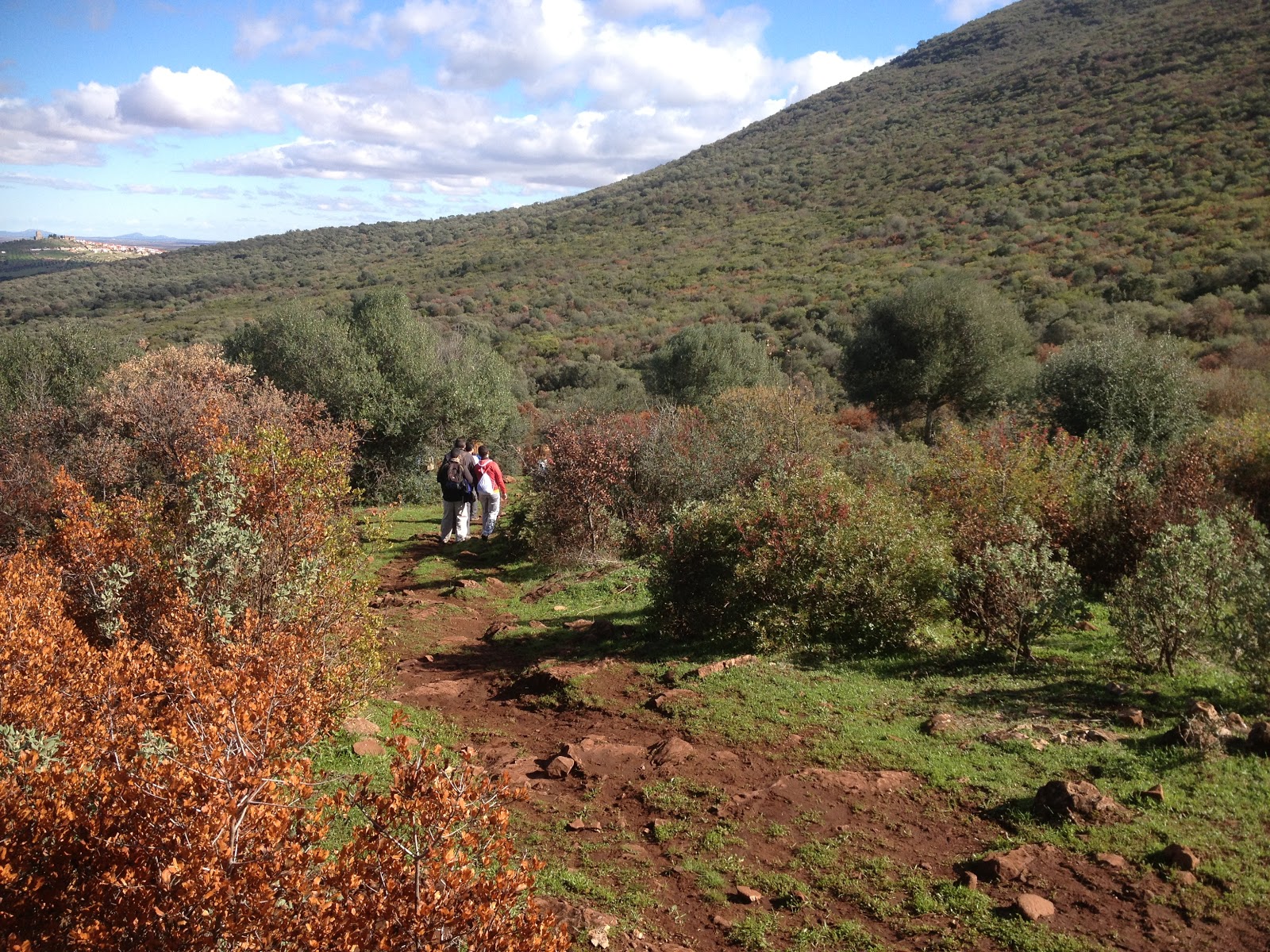
Anyway, an example of "Teresa doing something she'd never do in America": Hiking. It's not so much that I despise hiking or exercise, it's just that most of the time I'd rather do pretty much anything else. But my mentor invited me to go on an easy hike with her hiking club (Asociación Montañeros Vegas Altas), and I accepted.

We met at the Don Benito bus stop at about 8:45 on a recent Sunday morning. There were about 25 of us, with me being the only non-Spanish native. The great thing about doing things here with people I don't know is that my American-ness makes me inherently interesting. In America, I don't have that advantage with strangers.

I showed up woefully dressed. I was wearing tennis shoes, capri leggings and a "Nebraska" sweatshirt. Everyone made it known that my outfit was ludicrous and I was going to freeze. My explanation that I moved here from 4,500 miles away, and my hiking gear didn't make the cut when I packed my life into two suitcases fell on deaf ears. I actually don't even own any hiking gear, but that's neither here nor there...

The fellow hikers pooled some resources and graciously provided me with a zip-up sweatshirt, a windbreaker and a taller pair of socks.

My makeshift outfit, with my mentor, also named Teresa.
Then we headed to a 16-kilometer (10 miles) route called "Los Doce Apóstoles" (the 12 apostles) near Salvaleón in southern Extremadura.


View Larger Map

I made my mentor promise it would be easy before I agreed to go. It was easy, more or less, although it ended up being longer than 10 miles because we got lost in the forest. But the beautiful landscape and fresh air were worth every extra step - and I spoke Spanish most of the time, so no complaints here.

I believe these are the black Iberian pigs whose meat is so prized. Can anyone confirm?

I took this for my dad, a farmer who's always interested in agriculture elsewhere.


So glad I went. Here's to saying "yes" to new adventures.

Un saludo,
Teresa
Related Posts Plugin for WordPress, Blogger...