Showing posts with label spanish food. Show all posts

Saturday, November 30, 2013

52 signs you're an American in Spain


...because you can take the American out of America, but you can't take the, well, you know...
  1. You have a love/hate relationship with the siesta.  
  2. You're not a fan of dubbing. 
  3. You're really awkward with the double-kiss greeting.  
  4. Your English gets worse by the day. 
  5. You're waiting for Netflix and Pandora to get their you-know-what together and start functioning overseas. 
  6. You curse the lack of toilet paper, paper towels and/or soap in the bathrooms here. 
  7. You've explained countless times that rugby and American football are not the same. 
  8. Your internal meal bell still rings around noon and 6 p.m. 
  9. Cooking with butter reminds you of home.
  10. You've gone to the ethnic aisle to find peanut butter. 
  11. You have introduced said peanut butter to foreign friends. Their response was something along the lines of, "It tastes like peanuts," or my personal favorite, "Um, it's really thick."
  12. You've paid outrageous prices for said peanut butter, ingredients to make tacos or baking supplies.
  13. You wonder why anyone builds living quarters without an oven.
  14. You've corrected a Spaniard's English and then later realized it was actually correct in British English.
  15. You've been teased for your Central American/South American Spanish.
  16. You'll never be able to keep up with Spaniards on the social scene. Going out at 2 a.m. isn't easy. 
  17. You try to adapt your wardrobe to Europe, but on days when life sucks, you put on tennis shoes and your college sweatshirt and ask Europe to cut you some slack.
  18. You brought a college sweatshirt from home. Or four college sweatshirts from home. 
  19. You're the go-to expert on how life in America is/is not like it appears in the movies.
  20. Spaniards think it's weird that you wear socks around the house.
  21. Anywhere within eight or nine hours driving is a totally doable weekend trip. Spaniards don't agree. 
  22. You don't have the heart to tell Spaniards that you don't catch a cold from not wearing shoes in the house/not wearing a scarf/not buttoning your coat. 
  23. It's hard for you to understand that going to the doctor is free. As in, you don't have to pay. At all. No, really, you just go and then leave and keep your money.
  24. You see gas prices here and suddenly $3.50 a gallon seems like a bargain.
  25. You wonder why Europeans prefer hatchbacks over small sedans.
  26. You've had to explain to people back home that Spanish food is not Mexican.
  27. "Spicy" Spanish food doesn't seem remotely spicy to you. 
  28. Sometimes the whiny, entitled American comes out when you can't buy something at 1 a.m. or anytime on a Sunday.
  29. Your friends in America are 24 and married, while your friends in Spain are 30 and still staying out 'til 8 a.m.
  30. You've realized that wine and coffee in Spain are far superior and cheaper than in America. 
  31. You've told a Spaniard which part of the country you're from, and they've related your state/city to something from pop culture.
  32. Or they said, "That's in the north, right?" To which you've responded, "No, it's actually in the southwest/center/complete opposite part of the country."
  33. You've explained that Americans don't wear scary costumes for Halloween, and we instead use the holiday as an excuse to dress like an idiot or a lady of the night.
  34. When you visit the States or have a visitor in Spain, you stock up on food (i.e. Reese's) and cosmetics.
  35. You've realized Americans know nothing about European geography or politics.
  36. You've visited more of Spain than most Spaniards. 
  37. You've lost multiple battles against Spanish bureaucracy and customer service. 
  38. It took you months to stop apologizing to people who run into you on the street.
  39. Old people on park benches in the evening strikes you as the epitome of Spain.
  40. You regret not learning to drive a stick-shift (or you're really glad your parents made you do it). 
  41. You can point out America's flaws, but if a European does it you suddenly get all sensitive. It's like the great U.S. of A is your best friend or your mom. Nobody dogs on your mom.
  42. Sometimes the lack of political correctness in Spain makes you squirm.
  43. The Spanish practice of putting a heater under the table in the living room took some getting used to.
  44. You dearly miss your clothes dryer. 
  45. You'll never stop eating breakfast on the run/ordering coffee to go, even though it's totally un-Spanish. 
  46. You've yet to eat an American-caliber burger in Spain.
  47. You've explained that we don't eat burgers every day.
  48. You feel uncomfortable in McDonald's or Burger King because you feel like everyone there knows you're American and are therefore fulfilling the stereotype. 
  49. You have no good defense for, "That's why Americans are obese."
  50. You wonder why America doesn't have cañas.
  51. Given the crisis, you're thankful for the economic opportunities we have waiting for us in America.
  52. But you're not ready to pursue those opportunities yet because you're floating through your youth in Spain, where life is usually beautiful, sometimes frustrating, sometimes backwards, occasionally tears-inducing, mostly entertaining and always worth it.
Dear fellow countrymen and women, any signs you'd add to the list?


Tuesday, November 12, 2013

Stuff I Eat: Yemas de Ávila


The lack of recent posts about my culinary adventures doesn't mean I haven't been trying anything and everything edible (and some things that would be, by most definitions, inedible). Quite the opposite, actually. I've been too busy eating to write about how much I've been eating.


Name: Yemas de Ávila (Yemas de Santa Teresa)

Translation: Avila egg cakes (Saint Teresa egg cakes)

So what is it exactly? It's a pastry typical of the province of Avila. It's egg yolks mixed with a syrup made of sugar, cinnamon, lemon and water. The result is a soft yellow confectionery that I can best describe as a mix between a pastry (because it's soft and sweet) and a candy (because it's small and totally unlike a traditional bread-based pastry).

Where I ate it: Avila, Spain. I popped into a traditional pastry shop (the city is loaded with them) and bought a box. They're gold in food form. I don't say that for their yellow color but rather because I paid 5 euros for a box of 12 tiny yemas.

Before trying it, I was thinking...: "These look like lemon drops, but the fact that 'yolk' is in their name is throwing me off."

Texture: Because I anticipated something resembling lemon drops, I wasn't expecting them to be soft. Needless to say, I was surprised (unpleasantly, at first) to find that yemas are indeed barely solid. The exterior is slightly crispy, but it dissolves on contact with your tongue and gives way to the treat's gloriously gooey innards.

Taste: Given the ingredients (read: lots of sugar), it's very sweet. It tastes like a soft ball of sugary goo with a touch of lemon, all of which is given consistency by the yolk. They're slightly reminiscent of a gum drop, but they're softer and just plain better. I thought I would be able to taste egg in the yemas, but much like the eggs used in any other pastry, the egg-like flavor is completely disguised in the pastry.

Verdict: Heavenly...and way too easy to eat way too many. They're tiny but incredibly sweet. I'm a serious addict to sweets, so I could easily down a few of these at a time. But if you're not a fan of sweets, these golden balls of saintly deliciousness aren't intended for you.

It'd be blasphemous for me not to like something named for Saint Teresa, given she's my patron saint and namesake...I'm not much for blasphemy.


Wednesday, June 26, 2013

Stuff I eat: Lengua con alcaparras (tongue with capers)

I've been globetrotting for a while and journeyed back to the homeland last week, so I've been missing in action around here. I'll try to catch up as best I can.

I didn't intend for every food I featured on here to be gross, bizarre, better-in-the-garbage-than-on-your-plate type stuff. But it's managed to work out that way so far, and today's entry is no exception.


Source

Name: Llengua amb taperes

Translation: The name above is in Mallorquin, the local language of Majorca. It'd be "lengua con alcaparras" in Spanish and in English "tongue with capers," which are the unripened buds of a plant found in the Mediterranean.

So what is it exactly? It's veal tongue - boiled, peeled and cooked with onions, capers and tomatoes.

Where I ate it: Cura, Majorca, Spain (a small town in Majorca, one of the Balearic Islands)

Before trying it, I was thinking...: "It's amazing how many times I find myself in a situation where I'm eating oft-discarded animal parts. And if my dad were here he'd tell me I'd never eat this if he put it on my plate back home."

Texture: As tender as it gets. Knife not needed. You don't even need teeth, really. You could gum the stuff and enjoy it just the same. Now, in my last post about oxtail, I also talked about incredible tenderness but in a negative way. I said oxtail was so tender that it lacked substance. The good news is that veal tongue didn't dissolve in the same way oxtail did. You don't have to chew the tongue, but it doesn't immediately disintegrate either. It was a slow melt-in-the-mouth, one you could appreciate and enjoy. Luckily, the meat (which is really mostly muscle and fat) didn't linger long enough for me to really think about the fact that the stuff falling apart on my tongue was, well, tongue.

Taste: This may or may not be surprising, but the tongue tastes like...beef! Even better than that ambiguously generic "beef" description: It actually tasted like roast. Yes, roast. OK, wipe that disgusted look off your face and think about this: As this guy explains it, round steak, for example, is none more glamorous than butt. If you can eat butt, you can eat tongue.

As for the capers, although familiar to people raised in the Mediterranean (or in Mediterranean-like climates), they're nothing like anything this Midwesterner had tasted before. They're tiny but packed with flavor. They've got a tart, slightly bitter punch. They don't taste like Greek olives but have a similar sort of mild kick. Just try them.

Verdict: Absolutely delicious. I owe my Mallorquin friends big time for exposing me to two gross-but-actually-not-gross dishes: tongue and frito mallorquin, which is liver and blood. I enjoyed the tongue so much that I'm dying to try a tongue taco at a traditional Mexican taqueria.

I think there's one saying that's perfect here: One man's trash is another man's treasure. So here's to eating trash - and liking it.

Un saludo,
Teresa

Tuesday, May 28, 2013

Stuff I eat: Rabo de toro

I'm going to keep citing Anthony Bourdain until I run out of references. His quotes are like strings of sometimes-vulgar-but-always-poignant poetry: “That without experimentation, a willingness to ask questions and try new things, we shall surely become static, repetitive, moribund.” It's with that Bourdain-inspired mindset that I've tried blood sausage, pig ears, liver and...

Source
Name: Rabo de toro

Translation: Oxtail (the name used to refer to the tail of an actual ox, but it seems to have stuck even though what is served presently is the tail of cows and steers.)

So what is it exactly? Just what it sounds like. It's a traditional dish in Cordoba, served with the meat on the tail bone and bits of solidified fat. From what I'm told, it's traditionally seasoned with garlic, onion and vegetables to form a sort of stew. I tried it (for the second time) at a traditional Cordobese restaurant, assuming that if it was going to be life-alteringly delicious anywhere in Spain, it'd be there.

Where I ate it: Cordoba, Spain

Before trying it, I was thinking...: "I'm all for parts conservation and getting the most out of a slaughtered animal, but this really doesn't look good."

Texture: The meat is extremely tender and moist, and that's typically one of the dish's most lauded qualities. No chewing is required. Normally tenderness is the mark of a good cut, but I found oxtail to be so tender that it lost substance and so moist it bordered on slimy. (Keep in mind this is based entirely on my unenlightened culinary opinion. Many people love this dish.)

Taste: From what I could taste of the meager amount of meat on the bones, the meat was similar in taste to ribs (again, I warn you of my untrained palate). You're thinking, "Teresa, ribs are delicious." You're right, but the potential deliciousness of oxtail, which I think of as rump roast's ugly cousin, was drowned out by off-putting texture and yellow gelatinous fat.

Verdict: I wouldn't order oxtail in a restaurant because it'd cost me an hour's worth of private English lessons, and I'd rather spend that 10 to 15 euros on blood sausage or squid in ink than on oxtail. However, if someone else was paying, or if I was a guest in someone's home, I'd eat it again without quarrel.

Wednesday, April 17, 2013

"Stuff I Eat" - Spanish morcilla

I don't intend to reference Anthony Bourdain -- the "celebrity chef/world traveler/pithy quote machine/professional wise ass," as I described him last time -- in every food post, but it's just inevitable in this one. The dude loves "black pudding" for reasons I never quite understood. Coagulated blood and lard stuffed into intestinal casings just didn't pique my appetite. Any food for which you can say "the fresher the blood, the better" scares me a bit.

Even so, for a long time, I was admittedly intrigued by Bourdain's affinity for a food that looks like a bloody stool. When in Spain, do as the Spaniards do. That's my motto, and I'm sticking to it. In my inaugural issue of "Stuff I Eat," I mentioned that I'd be willing to eat a "bulging, deep-red intestine casing stuffed with throwaway mammal parts" if the opportunity presented itself. I meant it as much as a figure of speech as a legitimate vow, but I soon found a bulging intestine on my plate.  


Name: Morcilla de Guadalupe

Translation: Blood sausage, or "black pudding," from Guadalupe, Extremadura

So what is it exactly? Ingredients vary by country and region. As is obvious, blood is the star ingredient that gives the dish its off-putting name. Fillers can include barley, pork, beef, rice, onions, fat, cornmeal, chestnuts, potatoes, oatmeal or whatever else tickles the preparer's fancy, I suppose. I tried various kinds in Guadalupe, a small Extremaduran town that's famous for its blood sausage. One type had potatoes, I remember. But the one I'm featuring here is the most traditional; it had pig lard, cayenne pepper (or something of the sort to give it kick) and pig blood for sure. There may have been onions, garlic and cabbage, which are all typical ingredients, but I can't confirm that.

Where I ate it: At a small cafe near the monastery in Guadalupe, Extremadura

Before trying it, I was thinking...: "I've already eaten way too many typical-of-the-area sweets today, so if I'm going to pack my belly even more, this stuff better be dang good."

Texture: Very soft, even crumbly. Some people say "pudding-like," hence the name "black pudding," but from what I experienced, that's a misnomer. It's not creamy in the way I imagine pudding, but to each his own. Neither is it like the inside of a hotdog or typical sausage, which are more solid, less moist, and they don't fall apart in a dissolve-in-your-mouth kind of way, like morcilla does.

Taste: I'm not a food writer. I have no idea how to describe tastes and textures and presentation in an eloquent way that really conveys my experience. I can tell you what morcilla didn't taste like, though. It didn't taste like ground beef or pork; it didn't taste like sausage; it didn't taste like lard. It did have a strong flavor of cayenne pepper or whatever the spicy bit was. And given that there's blood in the sausage, it did have a hint of metallic-ness.

Verdict: Delicious and filling. It's not something that I could eat a lot of because it's got a unique flavor that could quickly become too much of a good thing. But given the chance to try it again, I wouldn't hesitate.

Other types of morcilla de Guadalupe that I tried. I don't remember what the darker one was, but the orange one was blood, mashed potatoes and something spicy.

Tuesday, April 2, 2013

Where in the world was Teresa Lostroh?

It's been a while since I've penned a travel dispatch. I'm trying to move away from the whole chronological "this is where I went, this is what I did" formula, but in case you're asking, "Where in the world was Teresa Lostroh?"....Stick with me. I promise there's an entertaining line or two.

1.) Tenerife, Canary Islands, Spain.
Went there for Los Carnavales, a Mardi Gras-esque liquor-fueled free-for-all. Was a tourist by day and a martian/some sort of Asian by night (we dressed up for Carnaval, in accordance with the custom). Felt like I landed on the moon when I visited the Teide Volcano, the world's third largest. Declared my panoramic shot of Los Gigantes (massive rock formations) the most epic ever. Ate three times my stomach's capacity at a typical Canarian eatery - and enjoyed every second of it. Got two Spanish friends to ask for a take-home food box for the first time in their lives. Broke my camera during an ill-advised self-timer attempt, therefore losing my beloved "vivid" setting forever.

Lunar landing?


The "Los Gigantes" panoramic


2). Mallorca (Majorca), Balearic Islands, Spain.
Was hoping for a glorious, snafu-less return trip to my favorite place on Earth. Went to the Cap de Fomentor peninsula on the island's northeastern tip, where I captured more epic panoramics and several Awkward Family Photo shots with my roommate. Also went to Sa Calobra, a remote cove reached by a mess of winding mountain roads. Went out, got my iPhone 4S and wallet stolen, effectively losing all photo evidence of the trip. So much for snafu-less. Thank goodness for memories. Ate fresh oranges from my friend's orange tree. I think the saying goes something like, "Once you go fresh oranges, you never go back." Let Mallorquin food win my heart even more (snails, bread, squid, vegetables, frito mallorquin, etc.) Spent Sunday in the obnoxiously Anglo neighborhood of Magaluf, where Spanish is a foreign language, Brits run amok shirtless and sunburned and Happy Hour starts at sunrise. Dipped into a bar at 7 p.m. that was packed with hammered middle-aged Brits reliving Spring Break. Jammed to lots of oldies and continued jamming even after the Brits' bedtime struck at 9:30.

Cap de Fomentor, Source

Magaluf, Source

3). Cordoba, Spain.
Split my heart in sixteenths as I fell in love with yet another colorful Spanish town. Got my mind blown by the Mezquita's wondrous mix of Christian and Muslim architecture. The place is huge. Went to a flamenco show in a nondescript basement on some Cordobese side street. Ate oxtail and flamenquin, a traditional dish of pork loin wrapped in ham, breaded and fried. Both dishes filled my belly but didn't change my life. Decided I must return when the city's ubiquitous residential courtyards are flush with May flowers.


Mezquita

Mezquita


4). Sevilla, Ronda, Trujillo, Granada, Malaga, and Nerja, Spain
Parents came to get a taste of la vida espanola. Cried when I met them at the train station in Sevilla (hey, it'd been five months). Launched a 10-day tourist blitz on this fine country. Did a generally terrible job of sharing with them the delights of Spanish cuisine (the best meal they had was at the hotel restaurant, without me). Made the mistake of ordering a fried seafood platter at a restaurant in the interior of the country. Acted as translator at a Case International implement dealer in Don Benito for my dad, who has an insatiable curiosity about agriculture no matter where he is. Took parents to Sevilla and Ronda, two places I'd already been. Forced my parents to be in more pictures together than they've been in over the past 35 years combined. That's not hyperbole. I'm serious. Went to a flamenco show in a kitschy tourist haunt in Sevilla. Enjoyed it despite its kitschy-ness. Fell in love with yet another pair of Spanish coastal towns, Malaga and Nerja. Pretty sure my parents are still talking about Malaga's marble sidewalks. Despite my love for Malaga and Nerja, thought both towns would be infinitely better if we could expel at least 70 percent of the northern Europeans and make the towns more authentically Spanish. Dad drove through snow - in southern Spain, of all places - to get to Granada, where that damned white powder covered the city for the first time in 25 years. Mom about lost her feet to frostbite while we tried (kind of in vain) to enjoy the Alhambra in the cold. Most importantly, was reminded of how awesomely loving, generous, fun and supportive my family is.

Plaza de Espana, Sevilla

Snowy Granada

Alhambra in Granada

Malaga from the fortress

5.) Toledo and Guadalupe, Spain
Have to wonder if my superlatives lose their weight when I overuse them: favorite, prettiest, most Spanish. But each trip manages to equal or top the previous. Loved Toledo's sublimely medieval core, which is on a hill reached by arched stone bridges. Toledo doesn't have the bright-colored buildings (much of the city is sandy stone) or the it-feels-like-this-entire-city-is-smiling vibe of Cordoba, but it's as genuinely Spanish. Guadalupe is what every small town should be: quaint, walkable, endearing, enchanting. It's all of those things despite the omnipresent tourist shops and carbon-copy signs hawking Guadalupe's typical blood sausage. Must admit the blood sausage is worthily hawk-able, though. Town's massive monastery has perhaps the loveliest courtyard I've seen yet. There I go with the superlatives again...

Toledo

Toledo

Guadalupe monastery

Guadalupe
Toledo

 That's the quick-and-dirty version of my life as of late.

Un saludo,
Teresa

Friday, March 22, 2013

"Stuff I Eat," the inaugural issue - Chipirones en su tinta con arroz

“Do we really want to travel in hermetically sealed popemobiles through the rural provinces of France, Mexico and the Far East, eating only in Hard Rock Cafes and McDonalds? Or do we want to eat without fear, tearing into the local stew, the humble taqueria's mystery meat, the sincerely offered gift of a lightly grilled fish head? I know what I want. I want it all. I want to try everything once.”

There's no one wiser than celebrity chef/world traveler/pithy quote machine/professional wise ass Anthony Bourdain, at least when it comes to the profundity of food and travel. He'll go anywhere and eat anything, no matter how shady the establishment, how raw the meat, how undead the fare.

I'm no foodie, but a girl's gotta eat. So I'm embarking on a a food adventure of my own. It's a challenge that really isn't a challenge at all: to try something new every week and write about it.

That pathogen-laden bottom feeder? Give me a hearty sidedish and a nearby bathroom and I'll try it. That foul cheese whose mold is spawning grandchildren mold of its own? I'll try it. That bulging, deep-red intestine casing stuffed with throwaway mammal parts? I'll try it.

Hungry yet?

But seriously, considering I have no idea what half of the food is on any given menu regardless of where I travel, it shouldn't be too hard to dominate this challenge. Food and culture are intricately linked, especially in Spain, so I figure it's wise to flavor my experience a bit.

So here goes nothing: "Stuff I Eat," the inaugural issue. 

 Source

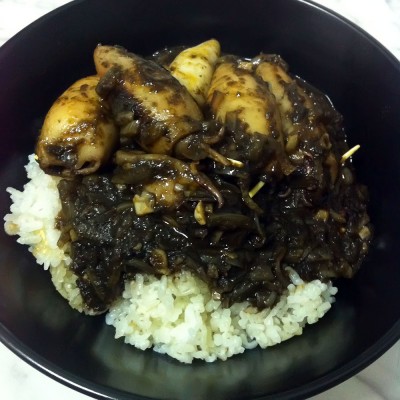
Name: Chipirones en su tinta con arroz

Translation: European squid in ink with rice

So what is it exactly? It's squid - full-bodied or sliced into rings - served with rice in an ink sauce flavored with garlic, onion, peppers, tomatoes, fish/chicken stock, etc. The fixings vary by the preparer, of course.

Where I ate it: In Don Benito, Spain, at a restaurant called "Cerveceria Gambrinus."

Before trying it, I was thinking...: "It kind of looks like the squid pooped on my rice." Then I wondered, "Do squid poop?"

Texture: Rubbery, gummy, as you might imagine. But it's not like I had to chomp mightily to get it down. I've eaten seafood in the past that pretty much exhausted my jaw. Fortunately, this wasn't like that. As for the ink sauce, it had the consistency of regular gravy.

Taste: Not a lot of it. It was supposed to be rich in garlic and onion, but it lacked a kick. The squid bodies themselves, which inside contained their tentacles, didn't have any notable flavor, either. It was a bit lifeless...pun intended?

Verdict: This dish has potential, and I would try it again without hesitation somewhere along the coast, where the squid is fresh and the preparation is a bit more inspired. 

Source

Until next time...
Un saludo,
Teresa
Related Posts Plugin for WordPress, Blogger...