Showing posts with label learning. Show all posts

Tuesday, April 22, 2014

As the page turns...

I still have three months left here, yet in a few clicks of a camera, a few swigs of badly mixed drinks, a few long nights and a few raw goodbyes, it'll be over. This book will be done, the present unfolding European adventure will have folded for good (or at least for two years). My story has been a wild one, more twisted, painful and rewarding than I could've ever predicted. I hope I will be able to say the same for the epilogue.

Closing out the final chapter of my Tales of Twenty-some Countries will be harder than it was to introduce the pursuit. But the epilogue is nothing to cry about. I've accepted a two-year graduate assistant position at the University of Nebraska-Lincoln, my alma mater, in the New Student Enrollment office.

I'll help coordinate, plan and implement orientation programs for new students, with special emphasis on international ones. I'll develop and direct an international-student seminar, run an English language group, arrange meals for foreign students with local families and create activities to increase interaction between foreigners and Americans. As part of the deal, the university is going to pay me for that job and even pay all of my Educational Administration Master's degree tuition. That's hard to pass up. So is finally being around to kiss my little gang of nieces and nephews, to join in family dinners and to dress in red on fall Saturdays with friends in Lincoln.

Even so, the decision hasn't been an easy one. I've had to turn down an opportunity to teach next year in the sunny, palm-tree lined coastal region of Spain that was just named the "world's best place for the good life." I guess I've chosen "The Good Life" over "the good life."

I believe our lives should read like a book. We are the protagonists in our own stories, and we must drive their course. There should be progress, excitement, inevitable lulls, a climax and a denouement. A good story has forward motion, a maturing plot and evolving characters. Happy endings are great but only if someone trudged through a patch of thorns in shorts to get there. I've recorded my narrative here, including my battles against the proverbial thorn patches that scratched me to sh**but ultimately left me better off. I hope to pen a happy ending here, too.

I've made a decision to keep moving and advance my story. So, here's to continuing to write one heck of a tale.

Sunday, October 13, 2013

Nine things you thought wrong about Morocco

A Spanish friend and I took a week and traversed the gut of Morocco. Much like I described the derelict parts of Bulgaria, the desolate, dog-eared side of Morocco has its charm. The half-finished buildings and the missing windows and the trash-strewn fields and the "toilets" at roadside stops all contribute to the intrigue and offbeat beauty of Morocco, a country that doesn't try to hide itself behind blush and high heels. You can’t fully understand and experience a country in seven days, but we got a pretty extensive glimpse into Moroccan life on the road from Marrakech to Fez and back. It was us, our van, the Sahara Desert, the Atlas Mountains and hundreds of kilometers of open highway. And wow, was it incredible.

Tinghir, palm tree oasis in the Sahara

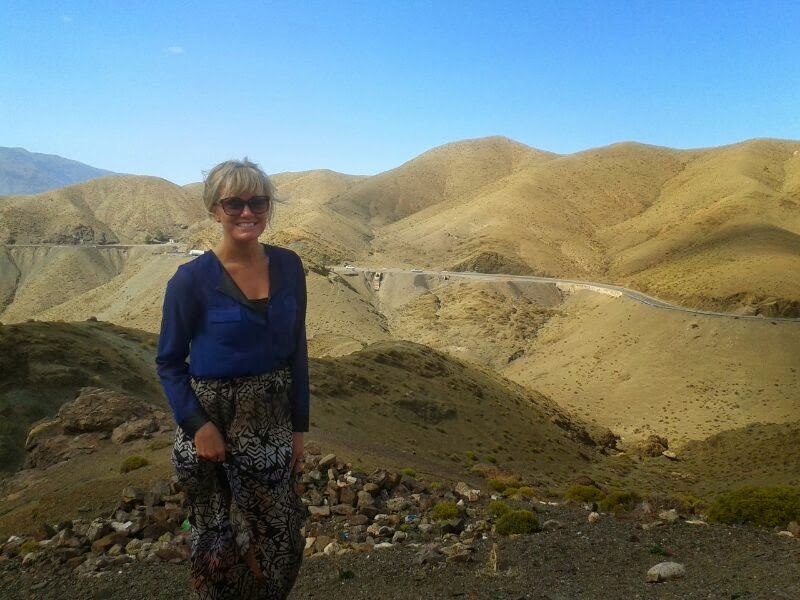
Atlas Mountains
I learned a lot in a short time on The Great Moroccan Road Trip. I realized that people know nothing about the country, that much of our “knowledge” of what Morocco is and isn’t comes from tall tales and TV shows. So, inspired by the bountiful tourist misconceptions, I’ve jotted down a list of things you thought wrong about the jewel of North Africa.

1. Police only want to rip off tourists.
This couldn't be further from the truth. I'd read horror stories of tourists being hassled for speeding and paying arbitrary fines on the spot. What if they took us for all we had? It's true the country is one giant speed trap. Police checkpoints are everywhere, and the speed limit signs are posted so close together it's impossible to obey them. But we passed through more than 15 stops, and every time, the officers saw we were tourists and let us on our way with a smile and a bit of elementary English or conversational Spanish.

2. The roads are awful.
Sure, they are not like U.S. highways, but anyone who expects them to be doesn't understand much about the world. Moroccan roads are narrow and generally lack asphalt shoulders, but they are in surprisingly good condition. The main and semi-main highways have gravel shoulders. We crossed the center of the country in a big van with no problem, and we didn’t use four-wheel drive. We navigated using street signs, a Michelin map and English/Spanish/broken French to ask for directions. We got lost a few times and cursed poor signage when we did. But guess what? We lived to tell the tale.


3. Going on a guided tour is the best way to see Morocco.
I don't doubt that the guided tours are great. But they aren't necessary. If you have someone who's comfortable handling tight curves on mountain roads and who's not intimidated by offensive and defensive driving, I'd recommend a road trip. The guided tours post their exact itineraries online. It's easy to find one you like and use it to plan your own adventure. Let it be known, however, that renting a car wasn't cheap (250 euros for four days, including extra insurance for peace of mind. I’ve read it’s cheaper if you rent from a local company.). Despite the expense, having a car was great for convenience and comfort. Do be advised, though, that passing through towns is like an obstacle course, but not a fun one. The only reward at the course's end is knowing you didn't crash into a donkey cart or run over a cloaked woman. The country is full of long-haul cabs that take tourists and locals to and fro, but they pack as many people as possible (plus one or two more) into those aging Mercedes. I imagine traveling in an overcrowded hotbox could make the red rocks of the Sahara look a little bit like the bowels of hell. 

Defensive driving at its finest.

Driving gave us the freedom to soak in views like this. 

4. Morocco is incredibly cheap.
This may have been true before the tourist boom, but Morocco is no off-the-map destination. It’s full of tourists, and the prices reflect that. You can find beds at well-reviewed youth hostels for about 9 euros a night per person (which is comparable to Budapest and Prague, for example), whereas nicer hotels are closer to 20 euros per person and up. It’s en vogue to renovate old homes and convert them into gorgeous hotels, and for how nice they are, they’re definitely cheaper than a similar lodging option in, say, Italy or Paris. But don’t think visiting Morocco with a clinking coin purse is sufficient. You’re going to spend a decent chunk of change if you want to see more than one city. You can find traditional food for around 3 euros a person, but if you’re more comfortable eating at tourist restaurants, expect to pay closer to 8 or 10 euros for a meal. As for souvenirs in the medinas, hard-line negotiation is a must. At most you should pay half the price vendors initially quote. 

The souks, Marrakech

5. Since it’s touristy, everyone speaks good English. 
Morocco is the first place I’ve visited where people were much more inclined to speak Spanish than English. Geographically, it makes sense, of course, given that it’s directly south of Spain. In Marrakech, the vendors spoke just about any language necessary to lure a customer in for a sale. But outside of Marrakech, I noticed English was much less common. When we camped in the Sahara, the workers all spoke great Spanish but limited English. Along our driving route, neither English nor Spanish worked well. Broken French was the best – and often only – way to communicate. This isn’t to say you can’t make it on English alone, of course, but it’s likely to be more difficult.

6. The Sahara Desert is made up of endless sand dunes.
You know that awesome footage you’ve seen on National Geographic of undulating mountains of powder-fine sand kissed by the desert sun? Most of the Moroccan Sahara is nothing like that. Much of it is rocky and dusty. Some is flat. Some is mountainous. The rest falls somewhere between the two extremes. There are two small parts, called the Erg Chebbi and Erg Chigaga, that are as orange and dune-y and spectacular as what Google boasts. But for reference, the Erg Chebbi is only 22 kilometers across at its widest. Think of that in terms of the expansiveness of the Sahara and you’ll realize it’s only a small blip on the map. 

This is the Sahara. 

So is this. 

And this. 

And this. 

And this, too. 

7. Moroccan men love to harass Western women.
Yes, some of them do offer camels in exchange for ladies, but the only time I heard such a proposal, it was a joke. Moroccans are sales people, and they’re tactical. If they see you looking at a map, they’ll offer to guide you to the location, hoping for a small service tip at the end. If you stop to look at their wares at a stand in the medina, they’ll often badger you to go inside to browse further and talk prices. The closer you get to the desert dunes, where tourism is the area’s lifeblood, the worse the hounding gets. Men will block the highway or flank your vehicle on their motorcycles to promote their sales pitch. But from what I saw, they did that to men and women alike. 

It didn't take much coercing to get me into the shops. 
8. Morocco is all desert. 
I'll let photos speak to the country's geographical diversity. 


9. The food and water will kill you. 
Oh, how we Westerners love to have our food packaged or pasteurized.  In Morocco, if you refuse to try any local fare, your overall experience will be as sterile as that pre-made supermarket sandwich you opted for at lunch. I found a dead, petrified bee in the taffy I bought from a street vendor, and I ate it anyway. I ate fresh salads, olives and fruit. I drank juice in the mornings and ordered traditional pastilla and cous cous at afternoon meals. At the Marrakech food market, I went as far as to eat the leftover eggplant off a stranger’s plate after she left (that was probably a bit too far, admittedly). In the end, my gut didn’t violently scold me, and as far as I know, my body hasn’t been ravaged by a tapeworm or pathogen. I never did drink the water, but I did brush my teeth with it. I wouldn't necessarily recommend my careless approach to eating whatever I saw, but a little culinary adventure is healthy. 

Delicious mixed salad

Pastilla, a traditional dish (often described as a "meat pie" of chicken) in a crepe-like crispy shell and topped with powdered sugar and cinnamon

Beautiful traditional sweets

Marrakech food market

So, with all that said, here’s to living and learning, to debunking myths and to spreading truth in a world of tales. 

Wednesday, October 2, 2013

On living anonymously

It's OK to fear starting over, to stew about the person people know you to be and how you want people to know the New You. It's scary to build yourself from scratch, to leave behind the people and places whose smells and smiles you recognize, whose presence is so intricately linked to your identity that you don't know who are are without them. 

We all have those people and places that help define us. There's that restaurant you go to when your diet crumbles and then there's the one you go to when you start anew. There's the rundown party house that reminds you of morning-after struggles with Captain Morgan and the tacky bar that'll always make you think of The One Who Got Away. And then there are the people who give these places meaning. 

In your new home, no one will be a pharmacist, cook, biggest fan, friend and listener quite like Mom. No one will affectionately and intentionally annoy you like your big brother. And no one will grip your secrets as tightly as your best friend. But there's something refreshing about living anonymously. Each day when I walk down the street, I see no one from my past. I only see people who may or may not be part of my future, people who may turn out to be my roommate's cousin's tutor or the worthless woman at the bank who's at work to do everything but her job. It's both terrifying and invigorating that people here aren't tied to milestones or mile markers back home. Restaurants and parks and street corners here aren't tied to memories. Everything is new, and so am I. 

With every person I meet, I can define my identity. No reputation precedes me. No yearbook entry tells people here I'm the most or least likely to succeed. No two degrees of separation tell a new acquaintance her roommate didn't like me in high school. I am Teresa, whoever that may be. I'm not saying I'm here "trying to find myself." That's a cliche, and nobody knows what the heck it really means, anyway. But starting over has an interesting way of sparking self-reflection, of making us question which parts of our former selves we'd like to conserve and which ones are better left to die along with the previous Me. So, as I stumble through this latest adventure, here's to Teresa being more thoughtful, less catty, more selfless, less volatile, more delicate with feelings and altogether less like the worst parts of the Old Me. Because sometimes it takes leaving behind who you were to realize who you'd like to be. 

Monday, December 17, 2012

It's not like getting paid is important, right?

I started work here in Spain on Oct. 1.
Today is December 17.
And I just got paid for the first time.

I hadn't received a dime for 2 1/2 months' worth of work until today. But this is Spain, after all, and knowing that there has been some pretty serious economic instability plaguing this lovely nation, I expected some delays. But I didn't realize payment would be pushed back as far as it was. There's been speculation that the Extremaduran government was trying to put off paying us until January to keep our salaries off the 2012 books -- with our pay included, the government hasn't complied with its budget.

Only after some other auxiliares mounted pressure on the Extremaduran government via angry, desperate letters and appeals to the press, we got paid. Ah, the power of bad publicity.

Story about our delayed pay in the "Hoy" paper of Extremadura.  Source
Speaking of bad publicity...

Apparently our lack of pay is normal around here, sadly. Read this New York Times story about how working and earning money aren't necessarily mutually inclusive for Spanish employees.

Un saludo,
Teresa

Sunday, December 16, 2012

A Spanish lesson

I came to Spain under the impression that I had a pretty good level of Spanish. I was far beyond basic survival Spanish. I knew enough to have a conversation more complex than the classic "what do you like to do?" and "tell me about your family." I knew more than simply enough to get me in and out of trouble; I could talk about politics, natural disasters and poverty.

Source
I'd grown accustomed to the Costa Rican accent (or lack thereof), Central Americans' more formal way of speaking and their vocabulary. There, car is carro, place is lugar, drive is manejar, juice is jugo and everything is lindo (cute, pretty, adorable, nice).

Then I came to Spain, southern Spain to boot. I've passed through periods here when I've lost all confidence in my Spanish. There have been multiple conversations in which I haven't understood a single word because the accent and colloquial usage of Spanish here is impossible at times. It can be soul-crushing.

Story of my life. Source
Here, car is coche, place is generally sitio, drive is conducir, juice is zumo and everything is bonito

But it's recently started to get better - right on time. Former auxiliares in Extremadura had warned us that it would take until Christmas to start feeling comfortable. Before coming, I didn't believe that.

Now I do.

So, while we're on the subject of Spanish, I'll give you all a quick lesson.

Read this list of words and while doing so, think of the appropriate English translation.

Compromiso
Fatal
Embarazada
Confidencia
Disco
Molestar
Constipado
Caramelos
Preservativo
Club
Actual
Jersey

Your translations are wrong, I would guess, unless you've studied Spanish at a level more advanced than middle- or high school language courses. The words above are "false cognates," meaning they look similar to English words but have different meanings.

Compromiso = commitment
Fatal = this can be "fatal," as in "deadly," but it's more commonly used to describe something terrible or awful

Embarazada = this is a classic Spanish 101 newbie error. Not "embarrassed," but rather "pregnant."
Confidencia = a secret

Disco = nothing to do with flower power or flared pants anymore. Disco is short for discoteca, a nightclub. It is a true cognate with "disc."

Molestar = nope, not referring to sexual abuse. This means "to bother."

Constipado = I learned this one here in Spain, as it's winter at the moment. This means "congested." "Constipated" is extreñido.
Caramelos = this doesn't necessarily mean caramels, although it can. More often, in Spain at least, caramelos are "candies."

Preservativo = in Spain, this is not what enables canned soup to last for centuries. That would be a conservante. This is a condom. My British roommate once said in an oral exam that she doesn't like how many preservativos are put in food. Laughter ensued.

Club = not a regular nightclub, but rather a place to see lady parts.

Actual = I commit this error often. This means "current," while "actual" would be real.
Jersey = You won't find names and numbers on this - it's a "sweater."


That's just a sampling of tricky ones. There are many more.

Here's to learning and improving every day.

Un saludo,
Teresa


Related Posts Plugin for WordPress, Blogger...